Keeping up with the jobs theme I guess, I was thinking more about how I "pay" Wally for jobs and tasks well done, or for doing well during training.
It's pretty simple here, everything he gets is something he considers to be "high value". In other words, this is something he is really excited about getting and really loves to have. For Wally, that's almost always some kind of food as he's highly food motivated. I always keep some bread or leftover pasta or some kind of tidbits he likes around so that I can capture things I like and it's always in reach for when I want to do some training or practicing some behaviors.
There's a couple ways to go with this. Some like to have varying degrees of reward, saving the best stuff for the hardest tasks and/or the best performances. Some just use one kind of reward - finding something the dog likes and just using it. I like to just use something he loves every time.
Along with the value of the reward, there's the frequency of reward. Some reward every single correct response, some require multiple correct responses before a reward. Really, each has a use during the training process and beyond into the "real world" where the behavior is asked for in a practical applications. During the early stages of learning and in beginning use in practical situations, a reward each time can be an advantage. Once the behavior is set and is reliable, switching to a more random frequency (and try to be truly random, don't do every 3rd success all the time, etc, dogs can indeed pick up on patterns like that) can make the dog much more willing to perform the behavior over and over again, in the hopes that this time, the reward will come.
So reward delivery can come in various flavors and styles, making for many ways to "pay" your dog for successful jobs well done. Eventually, the job hopefully will become a reward on some level in and of itself, and even the opportunity to do the job, but these things come later down the road after an established history of "good pay".
Saturday, March 19, 2011
Thursday, March 17, 2011
Job Creation For Wally
Cotons aren't noted for having "jobs" like a working or sporting breed, but I try to come up with things Wally can do for me as "jobs" that he is physically able to do and uses the behaviors he's already learned. So, like with a human job, I try to come up with Wally's "résumé" of sorts - a list of things he can do that could be put to work.
This will be something of a project for us but he has some of jobs already.
He enjoys doing these things. Seems like it gives him something to do and think about and of course he loves the praise and rewards he gets for a job well done. Then there's just another thing we can spend time together doing - all things dogs love. Hopefully, we'll be able to learn more behaviors and get better at these things so he can continue to learn and gain more confidence as a "houseworking dog" of sorts!
- Barks loudly, especially for the size of dog he his. Cotons don't have yippy, "little dog barks" and that's certainly true of Wally. This let's me hear him bark in almost every place in the house no matter where he is or I am.
- Likes to use his paws.
- Can push things with his nose
- Will stay in one spot if so instructed
- Has some ability to pick up small/light objects
This will be something of a project for us but he has some of jobs already.
- He opens and closes doors for me (though we are still working on the closing part, and developing new cues to make the sound distinct - for now we are using "abres" and "cierras" spanish for "open" and "close")
- Whenever a timer goes off in the kitchen or the kettle is whistling, he barks loudly so I can hear it, even if I can't hear the actual sound (like I'm in the basement). Sometimes he'll even hear the ding of the toaster oven timer from the basement and bark!
- We're working on this but if I drop something small or light, I'd like to have him pick it up and hold it for me. We're working on both the pick up and hold/carry, and him doing it when something drops without a verbal cue from me.
- If there were light switches on the floor, I'd have him push them with his paws, but alas...
- With planting season right around the corner, I wonder if he could dig holes in containers or loosen up the soil...
He enjoys doing these things. Seems like it gives him something to do and think about and of course he loves the praise and rewards he gets for a job well done. Then there's just another thing we can spend time together doing - all things dogs love. Hopefully, we'll be able to learn more behaviors and get better at these things so he can continue to learn and gain more confidence as a "houseworking dog" of sorts!

 Labels:
dog training,
eadt,
housework dog,
kinda working dog
Labels:
dog training,
eadt,
housework dog,
kinda working dog
Wednesday, March 16, 2011
Dog's Emotion: A Blessing For Wally and I
 |
| Wally expressing that's he's ready for action! |
Even then, it helped his learning, though not in a way I would want to repeat or try to recreate, but the strong fear emotions also made him remember what got him taken away from what he was fearful of. One way I didn't realize at the time was getting him to sit and/or indicate in his way to me what he was afraid of so I could deal with it and keep him from trying to strangle himself getting away. When he saw that sitting near me and staying close would get me to take him away, it ended up being something he remembered strongly. He learned this quickly as well.
Fast forward ahead about a year or so and the fear issues aren't the consuming thing for him anymore, and now the emotional intensity is on the other end of the scale, sheer excitement. This level of emotion worked the same way, with the added benefit of being an emotion I did want to trigger. Who doesn't like to see a happy and excited dog? What I learned, though, was that these emotions would cause the events that occurred while in that intense state to be more strongly remembered. So the things I could teach him while wound up and excited and super into the game or training we're doing, they would make a bigger "footprint" in his brain, making it easier for him to remember and making a bigger impression on him, so to speak.
So now, the first thing I like to do is get Wally wound up. I do what I can to get him excited, bouncy, and super alert and ready for action. Once he's had time to "charge up" we start going into the game or training we get into. I also use treats he loves (everything I use is 'high-value', meaning I only use treats he puts on his to-die-for list) which only helps keeping the spirits high, even if the task at hand is challenging and that he struggles with accomplishing.
There are other benefits to working him in this higher state of emotion:
- He learns how to think and perform behaviors when something excites him in "real life".
- He learns how to control himself during times of high emotion.
- The alertness and focus that occurs when he's like this also burns off energy, adding to any physical and mental energy he's consuming.
- It keeps the learning and training fun, making him want to participate in training again later.
- The fun he is having becomes part of the memory associated with the behavior and cues - a form of classical conditioning. Performing the behavior itself can trigger some of these feelings when the history is strong enough.
Of course, there's too much of a good thing - and if the dog is too wound up to where he's not able to perform with control and composure, or is unable to listen to your instructions, it's time to dial it down some so he can regain some self-control. Take a break, do something low intensity, whatever ways you have to calm the dog some so he can be in a more controlled state.
And of course, negative emotions are something you have to make the best of - obviously not something you want to trigger and cause your dog to intentionally endure - and the same rules apply: calm him down and withdraw him from the situation if he's so overwhelmed that he can't think (often called "shut down" or "the dog is shutting down"). At this state, there's no sense doing anything because he mind has "locked up" and is not processing rationally. Wait until he's settled down and try again.
Labels:
dog emotions,
dog training,
eadt
Tuesday, March 15, 2011
"All-Positive Monday" Results
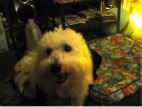
Wally getting into a training session
Well, the day of truly all-positive feedback (basically everything he did got him something he wants, be it food, a game, whatever) went well. I don't think Wally has any complaints, and I don't either, though I don't know if things really seemed all that different. Perhaps that is more an indication that my interaction with him is pretty close to where it didn't seem like an earth-shaking event for him.
One thing this approach did force me to do was to really watch him. Some things like the entrance to the kitchen (which he's not allowed in, but sometimes "goes a bit too far" and has to be redirected out) really had me watching so I could reward him for going up to the boundary line without having to redirect or say "at-at" and redirect him out of the kitchen. On his part, I think he saw it mostly like a shaping session and he was doing the right stuff I wanted so he was just lying down or standing up or sitting by the boundary with an occasional pawing of the boundary line just to remind me he's not past it.
A somewhat subtle thing he did was do the "right" thing more often elsewhere during the day. For example, when coming back in, he immediately went into the living room and sat down. Sometimes, he'll sniff around the hall or start sniffing along the hall or any objects on the bench before going to the spot in the living room. Not today, he went right there. Not sure if that was a byproduct of the approach or if there was nothing interesting to sniff! He also did it in my room, this time going up the door, which was closed, and barking. Now how is that something I want? Well, for one, he's not shy about expressing when he needs help, which given his old personality, is a good thing in my book. Before, he'd just look miserable by the door, but no one would know he needed something! But, perhaps even more so, the door blocked his way to his bed in my room, and that's where he usually goes! So, he wanted to get there, but couldn't, and was like "get this %&*(#% door open!" It didn't help it was a folding door, so he couldn't open it from outside the room.
Otherwise, there wasn't much of any difference in our day. He's usually a happy-go-lucky kinda dog that gets very into games and play and isn't shy about expressing his emotions - and that was more of the same today. He got into our training sessions as much as usual and ran through his arsenal of behaviors (seeming to prefer his "sit-pretty" or begging pose for some reason).
I may do this again sometime soon to see if there's any more differences the next time, but I'm thinking it won't make too much of a difference. Now, whether that's because I usually interact with him in about a "85% positive" way or because he didn't realize something was different, or if he just saw it as something totally different, not sure, but it certainly didn't hurt anything to try!
Sunday, March 13, 2011
No Punishment Monday - Attempting a Truly "All-Positive" Day
Whenever I hear "purely positive" training, I always cringe because I know there's going to be some negative punishment. The fact you don't give the dog a reward if he thinks his action will earn him one is negative punishment. That's just the way it is. To be truly "purely positive" you have to give a reward for EVERYTHING the dog does. That reward doesn't have to be food or even a click - it could be just giving him what he'll want in that situation.
So, tomorrow, I will try just that, just to see what happens. Well, I guess even then it's 99% because he still will not be allowed to do anything that disrespects someone else (or their property/pets/family), or anything that is unsafe, either for himself or others, but I don't think that will happen. It hasn't in a long time.
Otherwise, everything he does will get something he'll like/want. It will be interesting to see how this works out and what might change going forward, especially since there's not a lot of punishment going on here anyway, mostly during "formal" training (shaping, marker and reward or nothing), but there's not necessarily a lot of overt reward either. Most of the things he does, he's just "allowed" to do and generally gets little reaction from me.
It will also be interesting to see what he does differently, if anything. Perhaps he won't be able to tell a difference, and just act as he always does. Maybe I'll end up getting too many offered behaviors, where it will become more of an inconvenience than anything else, while doing nothing for him. Or perhaps it will have a...ahem...positive impact any maybe he gains more confidence or somehow all of his tricks and such become better.
Can't wait for tomorrow actually!
So, tomorrow, I will try just that, just to see what happens. Well, I guess even then it's 99% because he still will not be allowed to do anything that disrespects someone else (or their property/pets/family), or anything that is unsafe, either for himself or others, but I don't think that will happen. It hasn't in a long time.
Otherwise, everything he does will get something he'll like/want. It will be interesting to see how this works out and what might change going forward, especially since there's not a lot of punishment going on here anyway, mostly during "formal" training (shaping, marker and reward or nothing), but there's not necessarily a lot of overt reward either. Most of the things he does, he's just "allowed" to do and generally gets little reaction from me.
It will also be interesting to see what he does differently, if anything. Perhaps he won't be able to tell a difference, and just act as he always does. Maybe I'll end up getting too many offered behaviors, where it will become more of an inconvenience than anything else, while doing nothing for him. Or perhaps it will have a...ahem...positive impact any maybe he gains more confidence or somehow all of his tricks and such become better.
Can't wait for tomorrow actually!
Labels:
dog training,
eadt,
purely positive training
Subscribe to:
Posts (Atom)